15 Leading Business Messaging Platforms Compared in 2026
- Digital Nagma
- 4 days ago
- 6 min read


Business communication has changed a lot in recent years. While email is still around, today's companies need quicker, more cooperative, and safer ways to talk. That’s why we see business messaging apps growing—they let teams chat in real-time, share files, handle projects, and work together better no matter where they are.
For any company with remote workers, hybrid teams, or office-based crews, smooth communication is key to getting things done. These messaging platforms help staff swap info right away, lessen email clutter, and make decisions faster.
This guide looks at the top business messaging platforms in 2026, checking out what they do and helping you pick the one that fits your company best.
What Are Business Messaging Platforms?
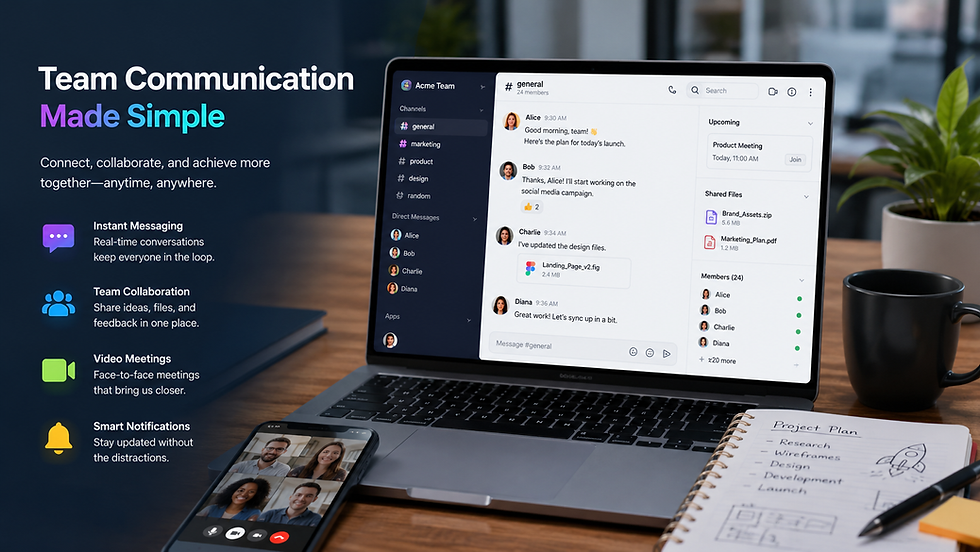
Business messaging platforms are software applications that help folks communicate and collaborate within workspaces. Unlike regular messaging apps, these tools offer serious security, control features, and automation along with teamwork utilities.
Key features usually include:
• Real-time chatting
• Group and channel conversations
• Voice and video calls
• Sharing files
• Findable chat histories
• Hookups with other services
• Safety and compliance measures
By putting all these communication tools in one place, teams can collaborate easier and get more done each day.
Why Businesses Need Messaging Platforms
Modern businesses face communication challenges due to distributed teams, remote work, multiple software systems, and increasing customer expectations. Business messaging platforms solve these problems by creating a unified communication environment.
Major benefits include:
Improved Team Collaboration
Employees can communicate instantly without waiting for email responses.
Faster Decision-Making
Real-time conversations accelerate project approvals and issue resolution.
Reduced Email Dependency
Teams spend less time managing overflowing inboxes.
Enhanced Productivity
Integrated workflows reduce context switching between tools.
Better Knowledge Sharing
Searchable conversations help employees find information quickly.
Remote Work Support
Distributed teams remain connected regardless of geographic location.
Key Features to Look For
When selecting a business messaging platform, evaluate the following features:
Security and Compliance: Look for encryption, access controls, audit logs, and compliance certifications.
Integrations: Choose software that integrates with CRM, project management, HR, and productivity tools.
Scalability: Ensure the platform can support organizational growth.
Video Conferencing: Built-in meetings improve collaboration.
Mobile Accessibility: Employees should communicate from anywhere.
Automation: Workflow automation can reduce repetitive tasks.
Analytics: Communication insights help improve team performance.
15 Best Business Messaging Platforms in 2026
1. Slack.
Slack is still one of the best tools for workplace communication. It has organized channels, direct messaging, workflow automation and thousands of integrations.
Pros:
• Easy to operate
• Awesome integrations
• Powerful search features
Cons:
• Can be expensive for larger teams
Best For:
Start-ups, SMBs and technology firms.
2. Microsoft Teams
Microsoft Teams is integrated into Microsoft 365. The ecosystem of organizations of Word, Excel, Outlook and SharePoint is very good.
Pros:
• Great Microsoft integration
• Security for enterprise
• Robust video conferencing
Cons:
• Learning curve for new user
Best For:
Microsoft-centric businesses and enterprise organizations.
DMStack
A single dashboard from DMStack lets a company manage customer conversations across multiple platforms. It’s about engagement, automation, lead management and messaging across channels to make it easier and more effective for customers to interact.
Pros:
• Omni-channel messaging support
• Automation features enabled by AI
• All your customer conversations in one place
Cons:
• Some advanced features may require a higher tier plan
Best For:
Small businesses, customer support teams & sales teams
4. Google Chat (Formerly Google Hangouts)
You can also chat in Google Chat with other apps in Google Workspace, such as Gmail, Docs, and Meet.
Pros:
• Interface clean
• Robust Google integration
• Simple deployment
Cons:
• Fewer advanced features than competitors
Best For:
Google Workspace users.
5. Team Chat in Zoom
Known for video conferencing, Zoom has grown its collaboration features with Team Chat.
Pros:
• Great meeting experience
• Integrated chat and videochat
• Intuitive interface
Cons:
• Collaboration features still developing
Best For:
Remote and hybrid teams.
6. Cisco Webex
Cisco Webex provides secure enterprise communication and advanced collaboration features.
Pros:
• Security that's enterprise-grade
• Performance you can count on
• Better meeting tools
Cons:
• Expensive
Best For:
Large companies.
7. Dischord
Originally created for gaming communities, Discord is increasingly used by startups and creative teams.
Pros:
• Channels for voice
• Creating community
• Cheap price
Cons:
• Restricted enterprise controls
Best For:
Communities and creative teams.
8. Mattermost
Mattermost is an open source collaboration platform with a focus on security and control.
Pros:
• Self-hosting options
• Robust security
• Personalizable
Cons:
• Requires technical skill
Best For:
Security-oriented organizations.
9. Rocket.Chat
Rohcket.Chat is another open-source messaging solution for businesses that want to own their data.
Pros:
• Deployments flexibles
• Open source
• Great customization
Cons:
Setup difficulty
Best For:
Organizations wanting total control.
10. Chanty
Chanty is messaging, to-do and collaboration in a simple interface.
Pros:
• Low prices
• Easy to adopt
• Task management included
Cons:
• Few enterprise features
Best For:
small enterprise
11. Flock
Flock offers messaging, video meetings, and productivity tools.
Pros:
• Easy to use
• Value for money
• Features of collaboration
Cons:
• Smaller ecosystem of integrations
Best For:
Expanding enterprises.
12. Team Messaging by RingCentral
RingCentral provides unified communications that include messaging, phone and video.
Pros:
• Communication in one place
• Good infrastructure
• Enterprise capabilities
Cons:
• Greater cost
Best For:
Companies requiring unified communications.
13. Meta Workplace
Workplace is all about social-style communication inside organizations.
Pros:
• Familiar UI
• Powerful engagement tools
• Community aspects
Cons:
• Less feature rich than enterprise-specific platforms
Best For:
Large organizations with a diverse workforce.
14. Cable
Wire stresses privacy and security.
Pros:
• E2E encryption
• Support for compliance
• Safe collaboration
Cons:
• Less integrations
Best For:
Security-aware companies.
15. Troop Messenger
Troop Messenger offers business communication features with robust administrative controls.
Pros:
• Encrypted messaging
• Sharing files
• Share screen
Cons:
• Smaller ecosystem
Best For:
Government and business market.
Comparison Table
Platform | Best For | Key Strength |
Slack | Startups | Extensive Integrations |
Microsoft Teams | Enterprises | Microsoft 365 Ecosystem |
Google Chat | Workspace Users | Simplicity & Ease of Use |
Zoom Team Chat | Remote Teams | Video Meeting Integration |
Cisco Webex | Enterprises | Enterprise-Grade Security |
Discord | Creative Teams | Community & Voice Channels |
Mattermost | Secure Organizations | Self-Hosting & Data Control |
Custom Deployments | Flexibility & Customization | |
Chanty | Small Businesses | Affordability |
Flock | SMBs | User-Friendly Interface |
RingCentral Team Messaging | Unified Communications | All-in-One Communication Suite |
DMStack | Customer-Focused Businesses | Omnichannel Messaging & AI Automation |
Workplace by Meta | Employee Engagement | Social Collaboration Experience |
Wire | Security-Conscious Businesses | End-to-End Encryption |
Troop Messenger | Enterprises | Advanced Administrative Controls |
Connecteam | Frontline Workers | Mobile-First Workforce Management |
Benefits of Business Messaging Software
The advantages of using business messaging software:
Centralized communication: Rather than communication being split between several disparate tools, an instant messaging platform will allow employees to collaborate on one central system.
Increased productivity: Instant messaging cuts down response times and helps keep tasks on track.
Improved team engagement: Messaging software can increase team transparency and team-working.
Enhanced security: Messaging software for businesses provides significantly better security than consumer messaging applications.
Improved customer service: Increased internal communication efficiency may result in better response times to customer queries.
Knowledge retention: An extensive history of conversation represents a repository of organizational knowledge.
Cost savings: An organization reduces its reliance on various communication tools.
How to Choose the Right Platform
Define Business Requirements
Determine team size, communication requirements, compliance needs, and integration concerns.
Evaluate Security
Verify as per industry standards and security practices that the platform is in a safe state.
Consider Scalability
Select a solution that can scale with your business.
Review User Experience
Have the software goes best.
Analyze Total Cost
Brought to you, think about licensing, implementation, training and maintenance costs.
Test Before Deployment
Try free trials or pilots before committing long term.
Future Trends in Business Messaging Platforms
AI-Powered Communication: Search, automation, summarization, and productivity are being enhanced by Artificial intelligence.
Unified Communication Platforms: More and more organizations are interested in a solutions that combine messaging, voice, and video.
Advanced Security: Security models of zero-trust along with advanced encryption are been gaining significance.
Workflow Automation: Automation features are gathering a ubiquitous currency.
Cross-Platform Collaboration: A time when cross-channel will be the norm, and future platforms will enable deeper integration across business ecosystems.
Conclusion
Business messaging platforms have emerged as invaluable tools for businesses of all sizes. By facilitating team communication, boosting productivity, promoting remote work, and enhancing internal coordination, they offer significant competitive advantages. Regardless of whether your company is a fast-growing startup looking for ease of use and rapid development or a large corporation with stringent security and compliance requirements, there is a solution designed to meet your specific needs.
Thoroughly assess your organization's communication needs, budget, and long-term vision to make the right choice that will lead your company towards enhanced productivity and future success.
Read More:
Frequently Asked Questions
Q. What is a business messaging platform?
A business messaging platform is software that allows employees to securely communicate and collaborate in a business environment.
Q. What is the best business messaging platform for a large enterprise?
Large companies should consider Microsoft Teams and Cisco Webex.
Q. What is the best business messaging platform for a small business?
Small companies could benefit from Slack, Chanty, and Flock.
Q. Are business messaging platforms secure?
For the enterprise, many platforms offer encryption, access control and compliances features.
Q. Can messaging platforms replace email?
They reduce email traffic greatly but can generally complement email usage rather than replace it.
Q. What are the most important features to consider?
Security, integrations, collaboration features, scalability, and mobile access should all be considered when evaluating a platform.


Comments